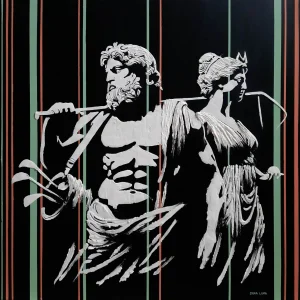
From Classical Beauty to Contemporary Ambition: The Roots of My Art
My work begins with a dialogue between two worlds that, at first sight, seem very distant from one another: the classical world of Greece and Rome and the restless, accelerated world in which we live today.
This dialogue is not something I have constructed only intellectually. It is part of my cultural background, my education and the landscape in which I grew up.
I was born in the Veneto region of Italy, in an environment where classical art and architecture are impossible to ignore. In Italy, the history of art is introduced from an early age through images of Greek temples, Roman architecture, ancient sculptures and the artists who rediscovered and transformed that heritage throughout the centuries. The pages of our schoolbooks are filled with references to the Greek and Hellenistic worlds, to Roman monuments, to Renaissance architecture and to Neoclassicism.
Among the artists who particularly shaped this visual vocabulary for me is Antonio Canova. His sculptures represent an extraordinary idea of beauty: controlled, harmonious, elegant and almost timeless. Canova’s work is part of a long fascination with antiquity, and his artistic legacy is preserved in a particularly meaningful place for me, the Museo Gypsotheca Antonio Canova in Possagno, not far from where I grew up. The museum preserves his plaster models and the memory of his studio practice, making the connection between classical inspiration and the Veneto landscape very tangible.
Another important presence in the artistic culture of my territory is Lorenzo Bartolini. His sculpture belongs to the nineteenth-century period in which the relationship with classical art was being reconsidered, moving between ideal beauty and a greater attention to nature and the human figure. His work reminds me that looking at classical art does not necessarily mean simply imitating it. It can also mean questioning it, interpreting it and bringing it into a different cultural moment.
Architecture has been equally important to me.
As an architect, I have always been particularly sensitive to proportion, structure, rhythm, light and the relationship between the human body and the surrounding space. Andrea Palladio is an unavoidable presence in the Veneto. His architecture was deeply based on the study of classical Roman architecture, and Vicenza and the surrounding territory still offer an extraordinary concentration of buildings in which this language can be experienced directly. The UNESCO World Heritage site includes the city of Vicenza and twenty-four Palladian villas scattered throughout the Veneto.
But Palladio is only part of the story.
The Veneto is filled with historic villas influenced by classical architecture, designed by Palladio and by other architects. The Italian landscape is also marked by churches and monumental buildings that repeatedly reinterpret the vocabulary of antiquity: columns, capitals, pilasters, pediments, symmetry and monumental proportions. Roman architecture is not simply something found in archaeological sites or museums. In Italy, it has survived through centuries of reinterpretation and has become part of the visual environment itself.
I believe this is one reason why classical forms feel so natural to me.
They are not distant images from another civilisation. They are part of the visual language through which I learned to look at the world.
Bringing the Classical World into the Present
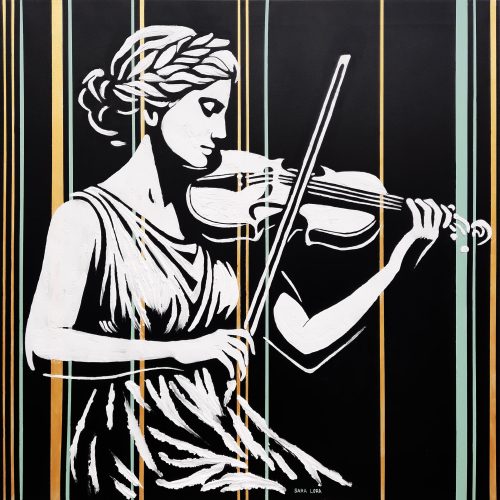
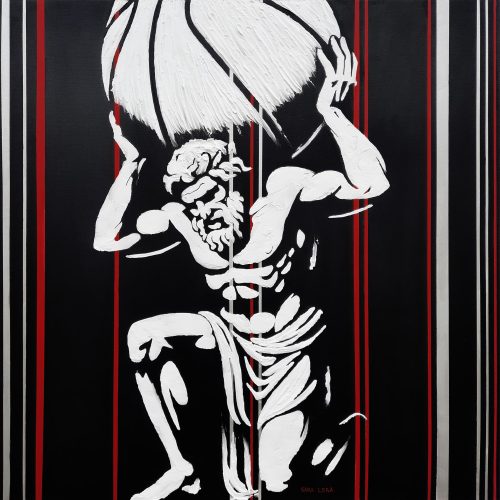
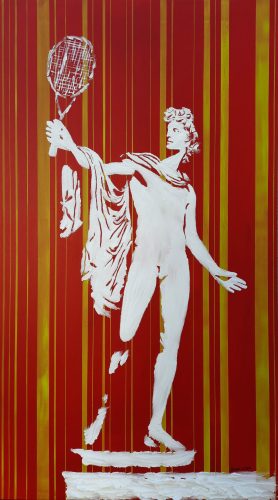
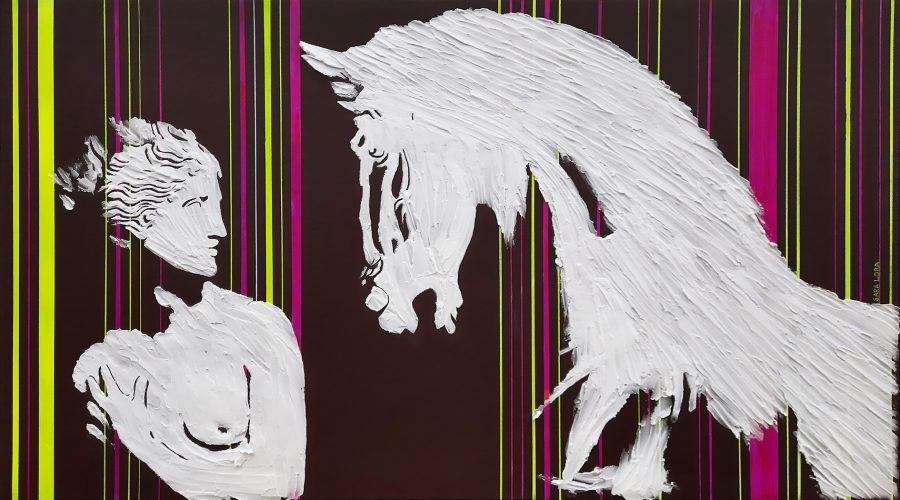
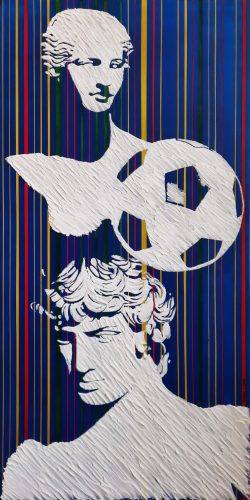
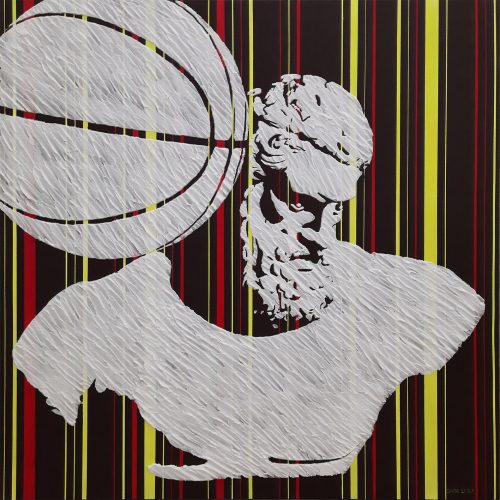
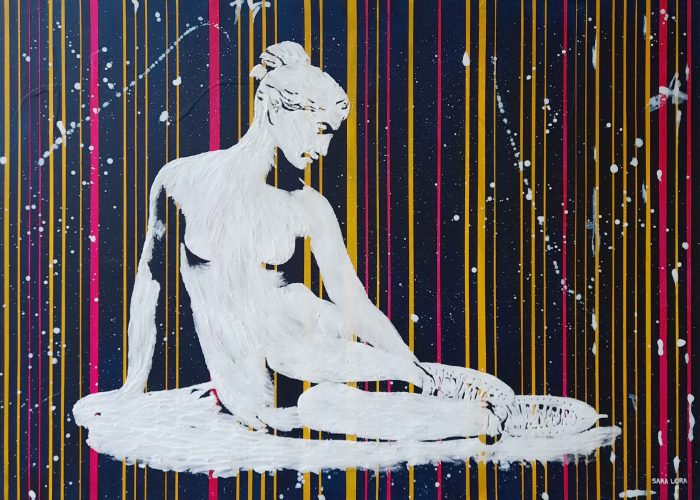
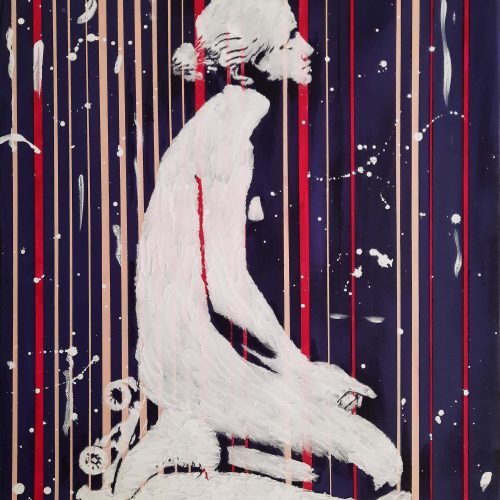
When I use classical-looking figures in my paintings, however, I am not trying to recreate antiquity.
I am interested in what happens when these figures enter our time.
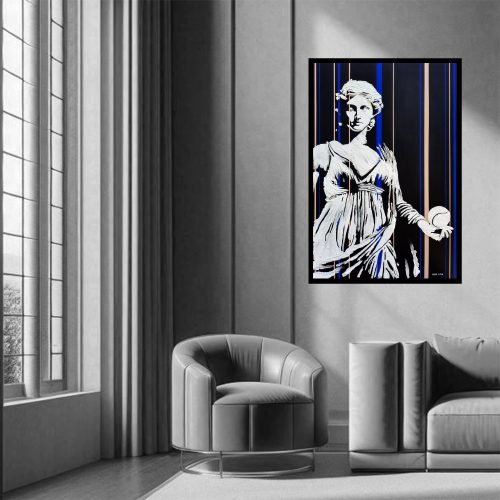
The bodies may recall Greek or Roman sculpture. The draped garments may evoke Neoclassicism. Their poses may suggest the calm and composure of statues.
But then something changes.
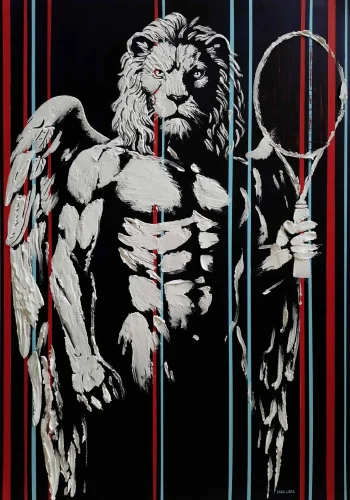
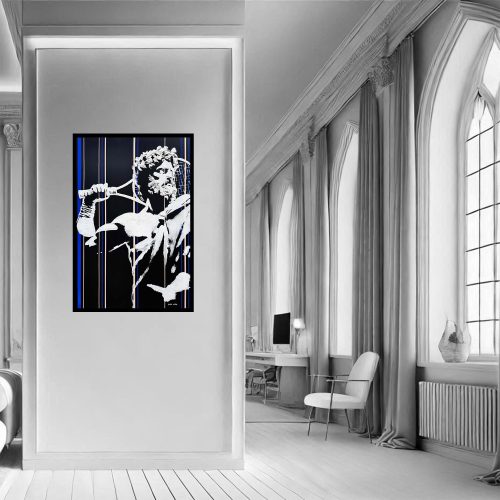
A tennis racket appears.
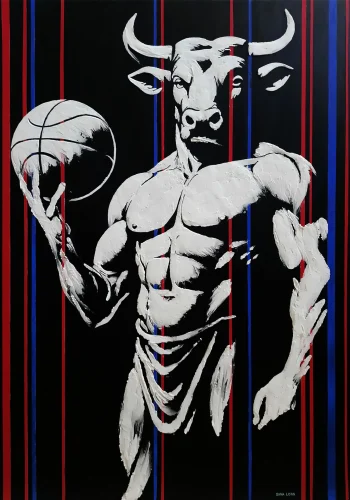
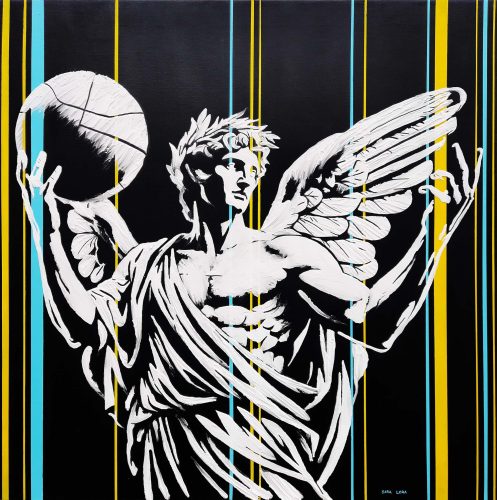
A basketball is held by a mythological figure.
Wings emerge from the body.
A classical figure becomes an athlete.
The setting becomes minimal. The background is no longer marble, stone or an ancient architectural environment, but an intense field of contemporary colour.
This is where my paintings begin to become something different from a simple homage to classical art.
I use the language of the past to talk about the present.
COLLECTION
The Modern Obsession with “More”
Our society is constantly telling us to become more.
More successful.
More attractive.
More fit.
More productive.
More wealthy.
More visible.
More influential.
We are encouraged to sculpt our bodies through sport and exercise, to pursue the perfect appearance, to follow changing standards of beauty, sometimes even through cosmetic surgery. We compete for prestigious jobs, higher incomes and greater recognition.
We travel more, photograph more, share more and measure our lives through numbers: followers, views, likes, achievements, rankings.
Everything seems to be moving faster.
And perhaps this is where the contrast with classical sculpture becomes particularly interesting.
A classical figure appears calm.
Its body may represent strength, but it does not appear to be rushing.
It does not seem to be checking the time.
It is not competing for attention.
It simply exists.
In my paintings, I deliberately place this sense of stillness next to symbols of contemporary ambition and competition.
The elegant drapery of a classical figure may coexist with a tennis racket. A serene mythological face may belong to an athlete. A body that seems frozen in marble may suddenly acquire wings, as though it were trying to go further, faster, higher.
The contradiction is intentional.
Is the Desire for More Actually a Bad Thing?
But there is another side to this question.
Is the desire to have more really something we should reject?
Perhaps not.
Wanting more can also mean wanting to improve.
It can mean becoming stronger, learning something new, working harder, overcoming our limitations and trying to create a better life.
Without ambition, many of the things we admire today would probably never exist.
Sport itself is based on this idea.
An athlete trains because yesterday’s performance is not enough.
An artist creates because the previous work is not the final one.
An architect studies because every project can become better.
Human beings are driven by the desire to go beyond themselves.
Perhaps this desire is one of the forces that keeps us alive.
The problem, for me, is not the desire for more.
It is the direction in which that desire takes us.
A Useful Game or a Dangerous One?
Ambition can be a powerful and constructive force.
It can push us to discover abilities we did not know we possessed. It can encourage discipline, creativity, courage and perseverance.
But the same mechanism can also become destructive when there is no longer a point at which we feel that we have enough.
More becomes never enough.
One achievement immediately creates the next expectation.
One physical transformation leads to another.
One professional success becomes the minimum required for the future.
One thousand followers become ten thousand.
Ten thousand become one hundred thousand.
The finish line keeps moving.
This is the tension I try to capture in my work.
My classical figures often appear relaxed, elegant and almost detached from the urgency of the world around them. Yet the objects and gestures I introduce tell a different story.
They speak about effort, competition, desire, pressure, aspiration and the need to excel.
The result is deliberately ambiguous.
I do not want to tell the viewer whether ambition is good or bad.
I am more interested in asking where it is taking us.
Between Stillness and Movement
Perhaps this is also why I am drawn to the combination of classical sculpture and sport.
They represent two apparently opposite ideas.
Classical sculpture suggests permanence, balance and restraint.
Sport suggests movement, competition, transformation and performance.
Yet both are deeply connected to the human body.
Both celebrate physical strength.
Both require discipline.
Both involve the pursuit of excellence.
Both can become expressions of identity.
And both can be beautiful.
In my We ART the Champions series, I try to bring these two worlds together without allowing either one to completely dominate the other.
The classical figure gives the contemporary subject a sense of timelessness.
The contemporary element, in return, gives the classical figure a new meaning.
The past becomes a mirror for the present.
And the present forces us to look at the past differently.
Why Classical Art Still Speaks to Us
For me, this is the enduring power of classical art.
It is not valuable simply because it is ancient.
It continues to speak because many of the questions it embodies are still ours: beauty, strength, ambition, desire, vulnerability, identity and the search for something greater than ourselves.
The forms may have changed.
The technologies have changed.
The pace of life has changed.
But the human being has not changed as much as we sometimes imagine.
We still want to become better.
We still want to be admired.
We still fear failure.
We still compare ourselves with others.
We still want to leave something behind.
My paintings are born somewhere inside this contradiction.
They look backwards in order to speak about the present.
They use the elegance of classical art, the visual memory of the Mediterranean world and the architectural culture of Italy, but place them inside a contemporary atmosphere of colour, movement and ambition.
Perhaps what I am ultimately searching for is not a rejection of ambition, but a balance between ambition and stillness.
Between wanting more and knowing when enough is enough.
Between movement and contemplation.
Between becoming and simply being.
That tension is where my art lives.
Get Connected
info@saralora.com